|
Introduction
The Wye Valley Line from Coleford to Newland once ran down the bottom of my garden, but that was long ago. There's no sign of the track now except for the sleepers which are being used for fencing, but the cutting is very clear and now acts as a driveway to a house. This is one of the many things which inspired me to trace and record the original tracks. Others include the tunnel at the Wye Valley Ghost Train geocache and the old bridge from Redbrook to Penallt, to name but a few. The local area comprised of the Wye Valley Line, the Severn and Wye Railway as well as the GWR Forest of Dean Branch and lines from Ross-on-Wye. These lines served local mines, works, quarries and passengers.
I must point out that I am not, and never have been a railway enthusiast. I approach this project from a mainly walking viewpoint, with some historic and architectural interest thrown in. I was the kid who had Scalextric and thought his brother's train set was really boring.
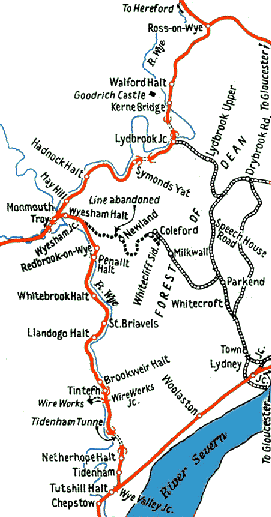
Ordinance survey Explorer maps
show where some of the tracks lay, but the trail tails off
in places. The first map I came across was this one, which
came from urban75.org.
It's very simplistic, and it's pretty clear that I'm going
to need a lot more than this to guide me round the actual
route, but it's a start.
The next resource I found was Vision
of Britain. Here there are maps from the 1930's and
as these railways operated from 1860's to 1960's this seemed
a good resource. The detail's not great, so I don't plan
to stop there. I mean to visit some local book shops as
soon as possible in Coleford
and Lydney and possibly the station
shop on the reopened Dean Forest Railway
at Norchard, which I seem to
recall stock loads of train related books from my visits
there with Will whilst visiting Thomas
the Tank Engine a few years back.
I've now acquired a A3 Midland Railway
Distance Diagram from 1917 and a huge map (1 inch:1
mile scale) of The Railways in Dean
Forest from 1880. This also marks the tramlines,
mines, works and collieries of the day.
 |
Newland Station
is almost my next door neighbour, only Newland
Tunnel is closer to my house. Both of the original
level crossing gates are still in place and are an
impressive sight as there is little memorabilia still
in place. |
|
|
| |
|
|
|
Blog |
|
|
|
Saturday 14th
October 2006 Newland to Wyesham
Bob and I started our quest
this morning. We left the house at about 08:00 and walked
down the cutting from Tunnel House
to the sawmill, just before Newland
Station (now Station House).
This was a beautiful avenue of trees, which I'm sure I'll
see over and over again during the next few weeks. There
was a tall, narrow building in a derelict state, but no
way out onto the path behind, so we retraced out tracks
and walked down the road to the station. The track ran just
a few dozen yards north of the Newland
to Redbrook road, so we tried
to pick up the trail by heading over the fields, but found
it was easiest to access from the afore mentioned road a
little further down. The track was better than I could have
imagined. We found signs of life in the form of a bench
by a make shift barbeque and something that resembled mini
buffers and then we came upon 3 or 4 caravans, smoke streaming
from a chimney. We kept walking as the obligatory dog barked
at us, but no sign of life. We ducked under the line of
rags hanging out to dry across the path and we were gone. |
The path grew narrower, less
like a railway track, but it was soon confirmed that all
was well. We were on top of the bridge near Swan
Pool. I'd been under it dozens of times and always
stopped to admire the craftsmanship that went into these
very large bridges. It seemed so small from on top, probably
because it was overgrown with young trees and shrubs.
The path opened out into a large track and when we checked
the GPS we were heading off up towards Staunton.
It was such a nice path that I was tempted to go, but we
needed to get this leg done. I'd come back and do that walk
another day. We shimmied down an embankment and entered
a field. This looked like where the track had been. I went
to look closer, but found I was sinking very rapidly in
the mud. It was like quick sand, and I got out pretty quickly
I can tell you. The mud was still well over the tops of
my feet though. We moved quietly as I'm not sure we should
have been there. We found the cutting again so knew we were
in the right place. |
 |
| 
|
Then we spotted it, what we were looking
for. The entrance to a tunnel. I had seen its photo, taken
in 1980 on Geograph,
but the co-ords were nowhere near here. As we approached
with stealth, two dogs at a farm on the hill started wailing
like banshees. This always happens just when you don't want
it to as I've found out during my Trigpointing
exploits. As we disappeared from sight at the bricked up
entrance, they stopped. The door was very rusted, but the
ground was higher than the door and it wasn't going to budge
so we climbed the embankment to Offa's
Dyke Path and looked for the other entrance. We found
it much sooner than expected. The geograph said it was 264
yds long, but it was nowhere near that. This end was completely
open, so along with my newest "must carry" accessory,
a torch, we entered the tunnel. I measured it at about 60
yds. It was incredibly clean and tidy inside and obviously
didn't get a lot of visitors. Tip: If you're taking pictures
in a tunnel, hold your breath, otherwise you get a ghostly
cloud across the scene. I've spoilt several photos in tunnels
and caves by not realising this. |
The author of the geograph has
now confirmed that this is Upper Redbrook
Tunnel, measuring 66 yds. After re-emerging from
the tunnel we soon had a slight detour as the undergrowth
was just too thick, but after only three minutes we had
found another tunnel. I love this project. The entrance
had again been bricked and a barred gate was padlocked.
But the lock was open! I could see immediately that this
was a longer tunnel than the last one. Water dripped into
puddles from the ceiling and junk was strewn inside. Actually
it wasn't really strewn, it was piled up. Concrete ornamental
wall blocks and polystyrene blocks, lots and lots of them,
mostly neatly piled against the wall. I counted the paces
off and after 150 began to hope that we could get out of
the other end. After 260yds we were there and although it
was bricked up, there was room to squeeze past a single
barred door. I now know this is Lower
Redbrook Tunnel. The length matches the description
of the geograph almost exactly. Unlike the previous tunnel,
which was straight, this had a bend in the middle taking
it from south westerly to almost north westerly.
Many thanks to Billy for the
update on the tunnels and the geograph.
|
 |

|
We were immediately on a lovely track through
Lord's Grove. It was easy from
here. No brambles, nettles or impassable sections, just
a lovely straight pathway through the trees. I could see
another possible track to my left just below me so I decided
I would take that return route rather than my planned Offa's
Dyke Path route. Beyond the track was the Redbrook
to Monmouth road and next to
that I could just about see the Wye
through the trees.
After a while the beautiful scenery turned to a dumping
ground. A car had been ditched down a slope. Empty bottles,
cans and litter were everywhere. Welcome to Wales.
Welcome to Wyesham. I just don't
understand why do people do this. It made the single crisp
packet I'd picked up earlier seem a bit pointless, but that
was all the rubbish I'd seen until now. I tried to figure
out where the tracks would have been, as the area has been
greatly developed in the last few decades. It would need
to swing round to join up with the bridges, but that's for
another day. |
I turned back and followed the
lower track. I reckoned this track would have crossed the
Wye at Redbrook
and the other track would have taken the tunnels to Newland.
When I got to Redbrook I was
sent sharply down to the road. The OS map shows this to
be the route of the track, but what was the sloping bridge
across the road for then? We crossed back over the bridge
to try to find where it joined up, but we found no easy
answers and I will return. I'd walked down the path leading
to Redbrook from the bridge dozens
of times, but never gave it a thought that it was the old
track. The were obviously works here as the stone ruins
bear testament. This track must have taken a siding at least.
It runs smoothly down to the Wye
bridge and the corners are sharp, but not too sharp.
Once in Redbrook we took French
Lane home. This is a pretty direct route which goes
straight over the top of the hill climbing 400 feet steadily.
There was a huge steel water tank, with ladders to the top,
which were locked off. But suddenly they have all been removed
without a trace. Cath told me she had to check she was in
the right place when she first noticed this the other week. |
 |
 |
Our first outing surpassed all expectations.
We'd discovered two tunnels, walked the top of a bridge
we'd never crossed before and most importantly found some
fantastic new places to walk near our home. This jaunt was
about 9 miles. In the afternoon we went down to Norchard
Station on the Dean Forest Railway,
which was open as they were having a steam day. We even
stopped at Whitecroft as the
train was waiting while they operated the level crossing,
so we got out and watched. We got to Norchard
before the train. I found a map of the Severn
and Wye Lines, but not the Wye
Valley Line. I called in at the specialist book shop
in Coleford, but they're shut
for a few days. The other shop in Lydney
seems to have gone. |
We started at 001 in Newland
and headed anti-clockwise. There's about another 1.5 miles
up to Wyesham and back off the
top left of the map.
Download
the gpx file. |
|
|
|
|
Sunday 15th October 2006
Newland to Whitecliff
The section from the Burial Path to Bells Grove is being re-written at the request of the land owners.
|
 |
We headed back into Bircham
Wood and picked up the track which led back
to the starting bridge over the steep hill which the
track detours around. I'd taken a stick with me today
and when I got to the bridge I felt it knock on something
solid. On further inspection I had discovered my first
railway sleeper of the project. In fact there were
a few here, with square GWR
bolts too. |
|
|
| |
 |
Not only were the sleepers camouflaged under
the early autumn leaf fall, but the bridge was very camouflaged
too. It was very overgrown and much higher than the stonework.
Maybe some earth had been piled on it, as the vegetation
seemed to thrive here.
When we got to the other side it was pretty difficult to
pick up the trail. We went back and forth several times.
I thought I'd found the track straight away, but a two foot
ridge across the track made me wonder if this was right.
In the end we decided it must be, and carried on. Besides,
even the topo map had this marked as a path, though I can't
imagine anyone had been down here for a very long time.
We found ourselves in Whitecliff Quarry;
no fences; no gates. The quarry (now a 4x4 centre) was deserted,
so we quietly followed the line we had plotted for the track.
The yard contains loads of relics, like old diggers, an
ancient steam engine, a restaurant car awaiting reconstruction
and many, many more. |
We didn't hang around too long and soon found
ourselves at the mouth of another small tunnel. This one
was about 270 feet and really clean. A tiny section of rails
was present, though the gauge seemed rather small, and some
more rails lay outside. (See, I do know some railway terms).
The rails were mounted on concrete blocks rather than wooden
sleepers. The far end was partially blocked by corrugated
iron and barbed wire, but was impassable. We zigzagged up
the road to the quarry itself. I've often walked along the
top to the Scowles, but it seemed
even bigger from here. I'd managed to mark the far end of
the tunnel on the GPS, so we navigated to that point, though
it proved impossible to get there from where we were as
we had climbed higher than we'd imagined. After half an
hour of trying we decided to call it a day. We had been
on the other side of the tunnel, or close by, a few times
before and knew it was easy enough to get to. |
 |
 |
Days Summary
Another great days tracking. We only did 5 miles today
and uncovered rather less track than we had anticipated
as we wanted to do all the way to Coleford,
but the going was much harder today. At least we got a pretty
difficult stretch under our belts. Again we discovered two
tunnels and two bridges, one of which we knew nothing of.
I had walked the section from Whitecliff
bridge towards Newland
once before, but had stopped well before reaching the new
bridge. This was when I was first discovering the area. |
| |
Track notes
We started at 001, without
really tracing any track, then drove to 002
and headed south doing the clockwise route then passed the
car to do Whitecliff
The lowercase b on Tunnel3b denotes it is an estimate from
map information rather than a marking by GPS.
I don't think I'll provide the gpx files until I've completed
a section of track, then I'll supply it for the track only,
cutting out my return routes and detours. |
|
|
 |
Sunday 22nd October 2006
Whitecliff to Milkwall via Coleford
We aptly parked up at the car park in Railway
Drive, Coleford next to Coleford
Junction station and traced our way back to Whitecliff.
We walked through the council office's car park along an
old high retaining wall. This was obviously were the track
once lay, and sure enough at the end stood the bridge which
crosses Newland Street. As expected
it was securely fenced off, with new spike topped gates
and razor wire. The top of the bridge itself was grass and
had apparently been mowed as it was very tidy. We retraced
our steps and then found a path by the bridge which took
us up to the track. This was the most overgrown section
yet. It was hard to tell where the line had been in some
places as the trees had grown large in it's path during
the last 90 years. After a while the track became apparent
again. |
We went past the Whitecliff
furnace, which is being renovated at the moment and
soon came to the Whitecliff Tunnel
covered in corrugated iron. I had found this tunnel a few
years ago and remember peering through the gaps to see an
old train in the tunnel. There was no light at the other
end then, so there must have been doors or similar. The
rock walls to the west side of the track were high here.
This section must have taken a lot of engineering. I may
do a section on some of the industry that the railway was
here to support. The furnace would be an ideal starting
place as it is well documented as Robert
Mushet is Coleford's most famous son.
Back at Coleford Junction, the
signal box and a goods shed have been preserved and turned
into a museum, with paraphernalia dotted around the yard
along with a tiny gauge rail track, though I have never
seen this in use. I guess the rest of the station has made
way for the car park and shops, but it's good that something
has remained and is obviously well cared for. |
 |
 |
Crossing the B4228
takes you straight to the first of the tracks which has
been converted to a cycle path. A Coleford
sign on sleepers, stating the altitude, stands at the start
of the track. These signs are used throughout the cycle
tracks and I'm sure there will be photos at a later stage.
We saw no bikes, but the path is well used by dog walkers.
The area was impressively clean and tidy for a urban path.
To the NE lies the Forest
of Dean Golf Club and to the SW an industrial area including
Mushet's Industrial Park. The
track is straight and meets the road at a nice wooden gate
in a miniature railway style with three sleepers inlaid
in the tarmac. The signs are done in a cycle / railway theme.
We got back to the car just before the heavens opened as
had been forecast.
I can't believe Garmin have
an icon for a Seaplane Base, a bell(?) and even a pizza,
but nothing for a railway station. |
Track notes
The blue flags are where I had plotted the track prior
to the walk. The detour away from the track is into the
centre of Coleford, then back
down Newland Street to get to
the bridge from the other side of the locked gate.
OK was where I was definitely
on the track and Track? was very
overgrown, so I wasn't sure if it was right. |
|
|
|
|

|
Tuesday 24th October 2006
Milkwall to Point Quarry
A short easy stretch, as Sid and Will came along today.
The cycle path continues past a home park and then into
the forest. Trees are either side of the path and form an
arch above. A stream runs along the east side, though the
path doesn't really resemble a railway track here. A very
pleasant stroll. |
 |
| |
|
|
|
We reached Darkhill
Ironworks. A display of mounted railway lines and
plaque reading "David Mushet 1772
- 1847 and son Robert Forester Mushet 1811 - 1891. Outstanding
Metallurgists. In this valley early experiments in the making
of STEEL and its alloys were carried out. Thus the age of
STEEL began." have been placed here by the Forest
of Dean Local History Society. It is very pertinent
that the first ever steel rails, used in 1857, where made
here, as was the first Tungsten Steel.
After the ironworks you pass Darkhill
on the other side of the track, then on to Fetter
Hill. The track crosses the road here and obviously
detours slightly to make a safe crossing. Soon after there
are iron railway fence posts indicating we are on the actual
railway line again, but very soon the railway track is off
20yds to the west of the cycle track. It drops well below
and can be seen from above. We saw no real value in hacking
our way through the undergrowth as we could see no objects
of real interest. We did spot one fence post, which was
the same as the one previously mentioned. By the time we
had reached another of the nameplates at Point
Quarry it was time for Sid to turn back, so we returned
on the route around the back of the ironworks and through
Gorsty Knoll on a beautiful autumn
day. |
| |
|
|
|
|
|
Sunday 5th November 2006
New Fancy to Moseley Green Tunnel
No updates for a while as I've been walking in the Brecon
Beacons over the last couple of weeks and doing a
fair amount of geocaching too.
I parked up at New Fancy and
headed east to pick up the railway track. I didn't realise
that the cycle track here was a siding to the colliery until
I got home and checked the map. I did remember seeing a
railway sign up here a few years back, so I'll have to revisit
soon. The main track is 1/3 mile east and runs next to the
cycle path. It's reasonably clear where it runs, but as
it crosses Fancy Road it's quite
hard to follow as earth must have been dumped over the original
track. We soon got back on track and stone walls on either
side told us we were coming to the tunnel. Unfortunately
it's another blocked off one, so we were forced to turn
back. The door was very rusted, though the padlock looked
pretty new. I didn't see any number painted by the entrance
as I have with all of the others. |
 |
| |
|
|
 |
The sun streamed in through the trees as
we retraced our steps, trying to find a better crossing
of the road this time. Again, looking at the Midland Railway
diagram now, we had discovered a siding, which ran parallel
to the tunnel and about half way down it. We followed the
cycle track past New Fancy and
north towards Saintlow Inclosure.
Vertical sleepers are standing either side of the path for
most of this stretch. The track has been converted to cycle
track right up to the Speech House
from here, so it should be very easy going. We headed west
and then south back to New Fancy
car park hoping to pick up the siding, but missed it. I
may even have the track logs from when I was there before,
as I recall I had just got my first GPSr (a yellow Garmin
eTrex) at the time. It may even have been the first
time I ever used it. |
| |
|
|
|
|
|
Sunday 12th November 2006
Blaisdon - Longhope
Bob and I did the Flaxley to
Longhope walk. This took in a
good section of the disused railway. We picked up the track
in an overgrown section by Blaisdon
Wood. After 1/4 mile we came out into a beautifully
manicured section covered in nice short lush grass. This
was used to service a Severn Trent
valve complex. It made great walking. We had to divert round
a private driveway at one point, but we were straight back
on the track. It was easy walking all the way to Longhope,
though at one point I'm sure the track would have run at
the bottom of some gardens, rather than on the track we
were walking. |
 |
| |
|
|
|
|
|
|
Sunday 19th November 2006
Biblins Footbridge - Monmouth
At the footbridge there are two paths. There's the main
cycle / footpath (though I don't ever recall seeing a bike
on it) and there's another of a similar width a few yards
further from the river. This second track is usually higher
than the first, but not always. I don't know if there were
two tracks, or if the cycle track was built at a later date.
The other is slightly overgrown in places, but is easily
passable at worst. I like this track as it's up close to
the cliff faces and you get a real feeling of what it must
have been like in the train rush past the rock a few feet
from you, with trees on the other side and then the river
only yards away.
We found the remnants of a building. There were about 8
large cylindrical containers embedded in the ground. I couldn't
tell how deep they were as there was water in the bottom
of all of them. I could see 6 - 8 feet down though. The
site was once a quarry, but I don't know what the vats were
for. If it was water for the trains I would have expected
them to be higher so that they could feed via gravity. There
were also a couple of small outbuildings nearby, but they
looked to be of more recent origin. |
| |
|
|
The path veered away from the track briefly,
but we managed to stay on the line, then we came to the
end of the forest. There was now a field between us and
the river and we were coming to the 90 degree bend before
you get to Monmouth. The track
went down the edge of the field and we followed it for a
while until we thought there was nothing to benefit from
this, and took the path next to it. The track is easy to
follow and there were some great tracks and lanes. Eventually
the track meets an industrial estate. In days past I guess
goods would move between the rail and river here. Finally
we came to May Hill where there
was once a station. I could see no sign of this, but will
return for a more in depth search.
There's a tiny section I need to do to join up this stretch
and Wyesham. |
 |
| |
|
|
|
|
|
 |
Sunday 26th November 2006
Biblins Footbridge - English Bicknor
We picked up from the footbridge again, but this time headed
east. Again we had the two tracks to choose from and again
some good cliffs in places. At one point a pool of fast
running water was fenced off between the paths. There was
no obvious place the water appeared from, so I assume it
was underground, but there was an old stone tunnel for it
to pass under the path nearest the river. This meant that
this wasn't a new path and had been there for many decades.
Maybe there had been two tracks after all. The river had
risen dramatically over the last week. The current was strong
and even this tributary was gushing powerfully.
The map is really unclear as to where the line ran once
you get to Symonds Yat, but there's
obviously a tunnel portal here, though I didn't see it.
I didn't waste much time though as I can get the car close
and come back for a hunt another day. |
| |
|
|
I took a detour from the track search and
walked around Huntsham Hill.
The map marked the exit portal reasonably well and as I
walked down the rocky hillside I had a feeling it was below
me, so we made a slight track back and found it easily.
Unfortunately it was locked, but there were a few brick
missing and we could see in at least. It's not the same
as walking the tunnel, but it's better than nothing. There
was a narrow entrance between the rocks and the rocks were
high above the top of the tunnel. The track continued on
along the bank on the river. The high cliff faces of Symonds
Yat Rock, Coldwell Rocks
and Ship Rock towered over us.
We found a very old building under Ship Rock. It was about
16' square and about 3' high. It can't have been used for
a long time as a mature tree was growing out of it.
Our journey was cut short as we approached Lord's
Grove, but a heard of large cows with calves. We
took no chances and left Welsh Bicknor
bridge for another day. We've done it many time before,
but have never been to look for the tunnel. I can't wait
to get out there again. |
 |
| |
|
|
|
|
|
 |
2nd December 2006
Redbrook - Brockweir
The old railway bridge in Redbrook
sees a lot of traffic. Not from trains, but from pedestrians
on their way to The Boat Inn
for a drink or for a walk round Penallt
or along the banks of the river. The footpath was tagged
on the side of the bridge when the tracks were ripped up
in around 1960. The bridge should soon see a £200,000
investment, not to see it upgraded, but just to keep it
in a safe, usable state. Once over the bridge you're in
Wales. The track lies between
the road and the path at the rivers edge. It stays a few
metres from the river all the way down to Tintern.
The first half of the stretch to Bigsweir
is a well maintained path with forests to the west and open
space to the River Wye to the
east. The Forestry Commission are managing the land. After
a while the track comes to an abrupt end by a house. The
route veers over a field. Strangely, there's still a slight
trail where the track lay until it meets the fields boundary.
A barbed wire fence in a poor state is no deterrent to a
tracker and on the other side the track was again clear. |
| |
|
|
The track was fenced from the adjoining fields,
yet sheep grazed along the track. There was an old bridge
with stone sides over a stream which lead to the river and
plenty of sleepers as usual. The final stretch opened into
a field and a gate with barbed wire wrapped around it told
us that maybe we weren't supposed to be here. Near the gate
stood an 8' post with a bent sign which could not be read.
I'm not sure if it had anything to do with the railway or
not.
We crossed the road by Bigsweir Bridge
and hopped a fence. This looked like it was owned by a fishing
outfit, so there was nobody in sight at this time of year.
An old shed, with doors raised from the ground stood close
by, but still no sign of the tracks. A gate brought us into
common land and another place we had been before. The track
is on a raised piece of land surrounded by crops and after
a while the track becomes more evident, but is fenced in.
We'd somehow found ourselves on this fenced in area once
before, but we negotiated the fence and strolled comfortably
until we reached the farm at the end. |
 |
| |
|
|
 |
Bob scrambled though a gap while I climbed
a gate trying not to draw attention from the farmers wife
who was walking around the garden. We soon made it down
the side of the church and picked up a footpath, but the
track was across a field again. We could see it soon lead
to a dead end, but we were determined to walk as much of
the track as we could so hopped a fence, walked the field
and then came back again. We had to circumnavigate the field
to join it on the other side of the fence. The next small
stretch was again a lovely maintained path, but all too
soon we were at a dead end. We found ourselves on a well
defined track with adjoining grazing fields. Despite a nearby
farm all went well until the track became less distinct
and then met a fence and turned into a jungle. We walked
along the road for a short while, as the track did run very
close to this road in it's day. When we met Brockweir
Bridge (1906) we crossed the bridge and turned back.
See the BLOG.
This stretch of track measured approximately 7 miles. |
| |
|
|
|
|
|
3rd December 2006
Saintlow Inclosure - The Dilke - Cinderford - Ruspidge -
Upper Soudley
There are two bridges very close together at Saintlow
Inclosure. They carry the track over wet land below,
but I couldn't see why they had been built. There must have
been a good reason to go to all that trouble. The track
is a cycle path now though is also home to walkers, joggers
and today a pack of llamas and a horse. After detouring
round the saw mill we came to Lightmoor
Colliery. This must have been a lovely building in
it's day. It looked pretty sturdy even now despite the lack
of windows and only the bare bones of a roof. The premises
are still busy, but this whole area must have buzzed with
industry a hundred years ago. The previous night had been
very windy and a tree was down over the path and would have
been impassable to a train. I wondered if these shallow
rooted fir trees were here back then, but as I passed Spruce
Ride I decided they probably were. |
 |
| |
|
|
 |
I'd driven over Dilke
Bridge hundreds of times without realizing it was
indeed a bridge over the old railway line. The bridge is
very similar in construction to Central
Bridge where we started out today. It's all stone
with a low wall along the top of the bridge. We carried
on north along the well defined path until it left the original
track. for 1/4 mile. We stayed with the track which we extremely
muddy. Some heavy machinery had been working around here
and the ground was black mush. It struck me as odd when
we visited Crabtree Hill Trig
Point a couple of months ago that this was very flat for
a trig point and completely surrounded by trees, so no line
of sight could be seen to other trig points (which is the
whole point of them). So these trees can't have been here
when the trig was built probably in the 1930's. A nice easy
stroll to the end of the Mineral loop
Line at the Drybrook Road
junction. We turned right and headed towards Cinderford.
This town is the most industrialized in the forest and has
to be my least favourite place in the area, but I guess
it does have an industrial history and there were quite
a maze of lines around here once. |
| |
|
|
Half way down this section we found a siding
to the south. A couple of pieces of railway debris lay about.
Old rotten metal cans and baths seem to be quite easy to
find. We followed the Main Line
for only 0.6 miles in total until we reached The
Forest of Dean Branch and headed south, initially
taking the wrong path. The track itself stood perched on
a ridge between trees. Some trees looked too old to have
grown since the railway went, but this was definitely the
track. The woods soon open to and industrial area and we
found what I believe was Letcher's Bridge.
There were the what looked like the stone sides of a bridge
with the top part missing and a large pipe running in its
place. Shortly afterwards is an information board relating
to Bilson Halt. The path was
wide here.
There are a series of ponds to the east of the track in
Linear Park, which would be a
nice place to visit if not for the factories. We walked
in the rain past the site of Cinderford
Ironworks. This place provided heavy industry from
1795 to 1894. The tramways would have served the works for
most of its life, not the railways. |
 |
| |
|
|
 |
Ruspidge Halt
has been preserved, although there's not a huge amount there.
A sign and two benches sit above the retaining wall on one
side of the track and a signal and a truck on a fenced off
section of track on the other side. It's great to see the
first signs of preservation on my wanderings. After such
a good section we crossed the B4226
and our luck immediately changed. The area is right on the
edge of the forest and is built up. The track went straight
into private property. We followed alongside the track in
the edge of the forest, but we were climbing well above
the track. Now we were stuck on the wrong side of a stream
which was well and truly a river at the moment. With slight
back tracking we crossed an overgrown bridge and made it
down into a locked up paddock and climbed over a high corrugated
iron clad gate to get back to the road. Sections here were
private / semi-private, but we followed the track where
possible until we got to Ruspidge Goods
Yard and the track went back into the forest by a
large stone marking The Blue Rock Trail.
The track followed Cinderford Brook
crossing it at times via bridges. We passed a disused quarry,
then came to what looked like Staple
Edge Halt, which is marked by a bench, though there
is no halt reference. |
| |
|
|
The last place of interest for the day soon
followed. At last we had found a tunnel. OK, so it was a
small tunnel and it was blocked at both ends without even
a door, but it was a tunnel. I couldn't figure out why it
was here though. It was right at the edge of a steep hill
and it should have been no problem for the track to detour
round the hill. The bend wasn't too sharp. But there must
have been a very good reason as this would have take a huge
effort to build. Very close by is a memorial to the 5,000
sheep culled in the forest in the 2001 foot and mouth epidemic
and also a picnic table and a wooden sculpture of a miner
lying on a trolley.
This was the end of our trail for today. We had completed
7 miles of track today. This weekend had seen 14 miles of
track and 25 miles walked in total. Bob had had a ball.
Let's just hope the weather holds out for the next few weekends. |
 |
| |
|
|
|
|
|

|
21st December 2006
Nailbridge - Drybrook - Lea
At 10:00 we parked up in the church car park in Quarry
Hill, Nailbridge. As we walked the few yards to where
the tracks would have run under the road it was easy to
see that this would have been quite an industrial area.
To the north the line ran up through what is now Hale's
timber yards. and came out of the rear of the property via
a bridge that carried the road above. A well worn track
and a broken fence saw us stay on course until a farmer
came to remind us that this was not a public right of way.
We played dumb and engaged him in a chat about the railway.
He was a pleasant enough chap, but was too young to give
me any information. He was under the impression that the
track ran further down the field as there was a visible
line there, but this was wrong as all the maps showed. We
found the nearest road via a wooden track / bridge which
crossed a bog. Bob got a shock when he ran through the wet
grass and found he was up to his neck in water. This was
the beginning of today's struggle to stay on the track.
We passed a house called Harry Hill
View. |
| |
|
|
We had to follow the roads of Drybrook
before coming to the point where we met up with the track
again. Another bridge saw the exit of the field, with the
track several yards below, but the other side of the bridge
was raised. I don't think there's a tunnel here. Maybe the
land has been filled. A house was being built directly above
where the track would have been. The field was being worked
by two hands, so I'll have to check back another day. At
last we found the railway cutting next to a public footpath.
We didn't have to follow it for too long before coming to
Drybrook Tunnel. It looked open,
then as you get closer you realize that there's a brick
wall 50 feet into the tunnel. Someone had tried to force
open the iron door, but to no avail. Pieces of industrial
junk lay around. We'd plotted the point where the north
portal lay, which was thankfully in the forest, so we set
off to find it. You need to be a little careful when approaching
the tunnel as you may find yourself dropping from above
the entrance if you're not on the ball. |
 |
| |
|
|
 |
The woods here are very beautiful and I can't
imagine they are used much. The wall lay 50 feet into the
tunnel again, but this time the door was open. After changing
the torch batteries we set off into the tunnel. It's the
first tunnel where I've noticed a distinct incline. As is
often the case, some sections are brick lined and then there's
a rock section. Most of the floor had been covered with
a smooth concrete layer, making walking very easy. A 10
foot room could be entered in the middle of the tunnel via
a small arched doorway. As we go close to the end there
were narrow gauge tracks with some decrepit old trucks.
This definitely wasn't the original track. There was also
cable, pots and machinery, but it was pretty tidy on the
whole. By the time we'd walked back to the north portal
we'd walked a mile underground. We stopped for a drink and
enjoyed the peace. Heading north we had a nice easy stretch
through forest. It didn't last long though, and we found
ourselves climbing through brambles and trees. We walked
sections alongside the track as it was such hard work. The
track itself stood on a raised ridge. |
| |
|
|
Things cleared again and the now well defined
path passed under a diagonal stone bridge and then on to
an area with loads of railway paraphernalia. The first thing
I noticed was a good section of track. This has been pretty
hard to find until now. There were a number of wagons, trucks
and piled up sleepers too. Last, but not least was what
appeared to be a tunnel entrance, though it wasn't facing
the direction of the track. Two doors securely barred my
entrance. Inside was no more than a small cave, presumably
used for storage of trucks, as the rails ran into the cavern.
We pressed on. A garage stood between us and where were
needed to go, but we were on raised ground and it's corrugated
roof was at floor level. A reinforced pathway had been constructed,
so I crossed carefully, though Bob just ran across. I had
visions of him crashing through the roof, but he's pretty
light fortunately. The farm house was very close, but the
fog gave good cover and we felt quite safe. After the next
field we were forced down the back of gardens to a point
where we could go no further without attracting attention.
Besides, a gaggle of geese were making a real racket. You've
got to know when to quit. |
 |
| |
|
|
 |
We hopped another fence and got back onto
the road, which passed between two sides of a bridge. The
top was no longer there. A Forest of
Dean boundary stone stood in the garden next to the
bridge. The track went through a farm, so we stuck to the
road until we got to a public footpath and crossed a field
to meet the track once more. This was the junction where
the line went west to Ross and
east to Gloucester. We hadn't
planned going west here, but the cutting was so nice that
we walked it for a while. Well, about a field or twos length
until it climbed back up to the level of the surrounding
land and became nothing special. In this short stretch there
was another lovely bridge with a shallow arch passing over
the track. We retraced our steps to the junction and climbed
a fence into an unused thicket to the side of the field.
Most of tracks we've come across have nothing at all growing
where they stood, but this stretch was totally overgrown.
We had a really tough job getting through, but we knew there
would be a fair amount of track round here that we wouldn't
be able to follow, so we had to make the most of any bits
that were possible. |
| |
|
|
A short stretch of field, followed by a muddy
path revealed cows blocked the way to a few new houses.
We were pretty sure we would not get past the houses so
went back to the road. After a fair diversion we arrived
at the other side of the houses. A building was signed Lea
Station. No way through was possible. This was becoming
a pain. The problem was that we were out of the forest and
the land was open, private and arable. We decided to just
enjoy the next couple of miles and forget about the track.
I sat on a stile on the edge of a wood to eat lunch. You
couldn't see half way across the field due to the fog. It
was strangely peaceful. I think I would like to have lived
in the days when these railways still ran. The world must
have been a quieter, slower, more relaxed place.
We crossed the A40 near Lynors
Farm and picked up the scent once more. We were looking
for a tunnel entrance as we came down the edge of the hill.
We found it alright, but the steep embankments made it hard
to get down there. We had to be careful as there was a house
nearby too. The portal was completely open, with no attempt
to block it. We hadn't seen many of these. |
 |
| |
|
|
 |
This was the wettest tunnel we had encountered.
The floor of the east half was mostly covered in water,
though you could generally dodge the water. I had good boots
on as always, so it wasn't a problem. The other unusual
thing about this tunnel was that it was perfectly straight.
You could see the daylight at the other end, even though
it was mainly blocked. This gave the impression that it
was shorter than it really was. In fact it was very close
to 0.5 miles long. Air bricks let in light at the westerly
end, but several had been removed and were only blocked
by a few piled up rocks. We could have emerged, but it was
getting dark and we had a long way to go to get home. The
GPS had already gone beep as it picked up the satellite
signal through the wall, but I stuck it through the gap
to get a more accurate reading. We walked back via the light
of the mini maglite, for what would be the last time as
it turned out that I'd got a cool Petzl
head torch for Christmas. We had fun scrambling up the embankment.
At first we just kept sliding back down, so had to find
an easier route. We climbed up, found our way back to the
road and completed the 16 mile journey down the Wysis
Way in the fog, then darkness. Great fun, but hard
work. |
| |
|
|
|
|
|
24th December 2006
Brockweir - Tintern Quarry
I parked up at Brockweir on
another misty day and walked Offa's
Dyke Path, past the Devil's Pulpit,
with it's excellent view down to Tintern
Abbey. It's a good climb and there are few views
due to the trees, but it made a great circular route to
the most southerly point of today's track expedition. My
route from Offa's Dyke Path to
the track was scuppered by a path marked on the map not
existing, so I diverted down the subsided quarry road that
zigzagged down the steep hillside towards the River
Wye. Our way was blocked by a disused quarry two
storey building with a large sign reading Get
out now. Bob went too close to the building and a
container next to it and a recorded message belted out over
a tanoy. Move away from the building.
Alarms have been triggered. We contemplated going
back, but just carried on in the end as we didn't fancy
climbing up the hill again. We found the track immediately
as there were again rails still in place. I didn't realize
that this is the spot I had visited on a geocache. It looked
different approaching from this direction. |
 |
| |
|
|
 |
We headed north, back towards Tintern.
Sleepers and rails were intact for a while, first the rails
disappeared, then the sleepers. I don't know why they were
left here. There's a lot of wood and steel. The path was
really pleasant and easy. I was surprised at how steeply
the track climbed here. We were about 170 feet above the
river. The path was obviously well walked and came out by
the river, opposite the ruins of Tintern
Abbey. I got a great surprise as there was another
tunnel. I didn't know that this one existed. If I had studied
the contours on the map it would have been obvious, but
I guess I had originally thought that the railway crossed
on the bridge at Tintern. This
was wrong. The bridge where it did cross no longer existed.
It must have crossed the river and then gone straight into
the tunnel. So far I've seen most tunnels bricked up with
a door built into the brick wall, or no attempt to deny
access, but this portal had a pair of 7' iron gates. They
looked as if they would be no problem to scale, but I wasn't
sure it was a good idea to take Bob on this one and it was
getting dark again. I didn't want to cross the river, so
found a route to near where the tunnel emerged by the river.
|
| |
|
|
We couldn't get down to the tunnel and weren't
that bothered as I can't imagine the tunnel will be blocked
at that end. We could have crossed the river and traced
the missing piece of track between Brockweir
and Tintern, but that should
be an easy bit to do another day, besides, the preserved
Tintern Station lies in this
stretch and light wasn't good enough to take photos. I could
see the station across the river with it's large sign proclaiming
the station name. We wandered back down the riverbank and
past the HAPPA centre to where
we'd parked up. This had been a really nice walk, though
we hadn't covered a great deal of track. |
 |
| |
|
|
|
|
|
 |
26th December 2006
Tintern Quarry - Tidenham Tunnel
We'd walked this section before, so Will came with me to
stretch his legs after the Christmas excesses. He had loved
the story about the quarry alarm and I had to convince him
it wasn't a good idea to do it again. We picked up from
where we'd left off, though this time we came from the direction
we knew. We passed under our start point via a small 65
metre tunnel. The sleepers and rails ran for the full length
of today's section. This path must be much less utilized
than then stretch up to Tintern
as it was a little overgrown in places. It passes very close
to the quarry building. This stretch is below the subsided
road and a lot of rock has tumbled onto the track. There's
a buffer here and a couple of old stone ruins. The track
runs very close to a very steep drop in places so care is
needed. We also found a small cave which we hadn't noticed
before. |
| |
|
|
It's a brilliant tunnel. Not barricaded at
either end. It's probably the longest tunnel I've been down
as it clocks in at almost 0.75 miles. It's only unusual
feature is that there is a shaft to the surface in the middle
of the tunnel. You can turn your torch off here and see
OK. The Petzel MYO5 torch got
a good workout. It's incredibly bright on the xenon beam,
but the led mode is great for walking as it lights the ground
around you and lasts for up to 70 hours in this mode. I
tried on Christmas day walking over the fields in the evening.
Never again will I be constrained to walking in daylight
hours only.
Will really enjoyed then tunnel, he thought it was a great
adventure. At the south easterly portal we scrambled up
the bank. The track is very overgrown here, so I'm not relishing
the thought of this short section. There's a bridge just
a few yards from the tunnel portal which seems odd. We walked
back via the Gloucestershire Way.
There's just one field where the owners have done their
best to conceal the public right of way. How annoying is
that? |
 |
| |
|
|
|
|
|
 |
2nd January 2007
English Bicknor - Coppet Hill Tunnel
I started the New Year in the same way I'd left the old
one - in the company of my young helper, Will. It was the
last day off before going back to work. The weather had
been pretty bad recently, so we decided to make the most
of our last day anyway. I parked by the old HW Smith/Reed/SCA
factory near Lydbrook. We walked
over the railway bridge to investigate the tunnel first.
After stopping at the pill box (which is open) we found
that the breeze blocks at the south portal had been demolished.
The tunnel was very wet indeed. There were several inches
of water for as far as you could see with a torch. We had
a couple of miles of track to the west to trace, so we left
the tunnel for now. We'd wanted to get to the tunnel on
26/11/2006, but were forced back by cows, so we went to
meet the point where we'd got to. The factory has been closed
for three years now, and is beginning to look pretty derelict.
The line looked like it ran right up to the building. There
was a signal pylon left in place. The whole place was fenced
and locked, so we traced the perimeter. |
| |
|
|
No cows today and just one detour into a
fenced narrow strip where the track ran, otherwise the track
ran on public paths. We followed the main path closer to
the river back to the starting point. I'd been researching
Lydbrook Viaduct the previous
night, so we had quick look to see if we could see the stone
anchor points on the way past in the car. The west side
was easily visible. After lunch we parked up at Kerne
Bridge and went to look for the other tunnel portal.
The track didn't cross this bridge, however the bridge it
did cross half a mile downstream was no longer in existence.
We walked to this point and then picked up the track quite
easily. A lone house stands by the side of the track here.
Another half a mile and we were at the tunnel. Once again
it looked like a JCB had been used to knock a significant
hole in the blocked entrance. The cross section of the tunnel
was much taller than the others I'd seen and was quite egg-shaped.
This end was dry. Well as dry as anywhere can be at the
moment. We walked the length of the tunnel and found it
was only the last 30 yds that were submerged, so didn't
bother to wade through the water. Instead we turned back
and walked the length of the tunnel again, which turned
out to be about 1/3 mile. |
 |
| |
|
|
 |
Will's getting pretty good at tunnels now,
especially if he gets to wear the head torch. The photographs
give a very false impression as the flash lights them well.
They are, of course, pitch dark for most of their length.
As usual, this was not a straight tunnel, so became dark
very quickly. For most of it's length it's walls were composed
of medium sized stones and a narrow section of brick work
ran in a strip along the ceiling. We'd looked for the air
shafts, which were marked on the map, near the south portal,
but could see nothing. We emerged once more back onto the
muddy track. Once we again reached the point where the bridge
once existed we had a better look to see where it joined
the other bank, but though there was an obvious base on
this side, nothing could be seen on the other side. It must
have been quite a long bridge too as it crossed the river
at a shallow angle. I'm sure we'll investigate this more
very soon. |
| |
|
|
|
|
|
March - June 2007
Lydbrook Viaduct
I've walked this short stretch many times from the railway
bridge at Welsh Bicknor to up
past the viaduct at Lydbrook.
There are plenty of photos of the viaduct on the Internet,
especially of it being decommissioned in 1965. It stood
90 feet above the road and was an impressive sight, or so
I believe from the photos I've seen. The arches are no longer
there, but I did find the point where the viaduct left the
ground at both ends. The eastern end is very simple to find
as it is right by a public footpath, but the western end
is altogether harder to find. Having said that, if you walk
down the old cutting, despite being somewhat rugged, it
can easily be found. Otherwise a fence will come between
you and it.
I carried on walking up the track until we came to a stretch
which was a private driveway. There were some interesting
steps, walls and retaining walls along the way as if there
had possibly been a station here at one point. |
| |
|
|
|
| |
|
|
|
|
|
17th June 2007
Meiry Stock
One of the reasons I've not walked a lot of track in the
last 6 months is that much of what is left is cycle track
and it really doesn't interest me that much. For an easy
Sunday stroll I was accompanied by Will on his bike. We
parked a mile south of Meiry Stock Tunnel
and tried to follow the overgrown path that would have been
the Speculation Siding. It was
hard work with a bike and there was very little to see.
As we joined the main line we soon came to a lovely bridge,
just standing in the middle of the forest. As we stood on
the bridge we could see the tunnel a couple of hundred feet
in front of us. It's an oval portal which has been bricked,
with a steel barred gate. One bar of the gate has been removed,
but there's no way I could fit through and it looks very
muddy in there. The spelling is interesting as the buffer/sleeper
nameplate states Mierystock Tunnel
and Mirystock Bridge, whilst
old maps are marked Miery Stock Tunnel.
Mind you, there's a new road sign at May
Hill that says Mitchel Dean.
It's Mitcheldean if you don't
know. |
 |
| |
|
|
 |
The north portal is on the other side of
the A4136 (Monmouth
to Gloucester road). It's a sad
sight as it's been covered over with earth. There is an
unimpressive FC sign which I've quoted below. Note yet another
spelling of the name. The inscription on the key stone reads
A-D 1874. I believe a bunch of
locals tried to clear the tunnel entrance using a JCB a
few years back so that their kids could safely cross the
busy road on their bikes, but the move was thwarted. As
you can imagine, nothing exists of the railway here as everything
has 30 feet of earth piled on top of it.
We returned the way we had come, but then ignored the siding
and stuck to the main line which took us up to Drybrook
Road Junction. It's cycle track all the way, though
there are plenty of relics about. Sleepers stand vertically
for pretty much all of the route and there's a long bridge
on the way too, though it's not the prettiest I've seen.
We neared Whitegates Junction
an then returned home. |
| |
Mireystock (Mierystock) Tunnel
The engineering company J.E. Billups of Cardiff who also
constructed Mireystock Bridge and the masonry work on the
Lydbrook viaduct commenced construction of the tunnel in
1872 using forest stone. The tunnel is 221 metres in length
and took 2 years to construct. The tunnel allowed the connection
of the Severn and Wye Valley railway running from Lydney
with the Ross and Monmouth network at Lydbrook. The first
mineral train passed through the tunnel on 16 August 1874.
Passenger services commenced in September 1875 pulled by
the engine Robin Hood.
The history of this section of line is not
without incident - a railway ganger was killed in the tunnel
by a train in 1893 and a locomotive was derailed by a fallen
block of stone in the cutting at the northern entrance in
1898.
The line officially closed to passenger trains
in July 1929 but goods trains continued to use the line
until the closure of Arthur & Edward Colliery at Waterloo
in 1959 and Cannop Colliery in 1960. Lifting of the track
was completed in 1962. The tunnel and cutting were buried
with spoil in the early 1970's.
Thanks to the vision and enthusiasm of a
group of local Forest railway enthusiasts assisted by Forest
Enterprise the top of the northern portal of the tunnel
(with its unusual elliptical shape) which has lain buried
for 30 years has now been exposed. |
| |
|
|
|
|
|
22nd June 2007
Tintern Tunnel
I needed to come on my own to do this tunnel, as there's
a 7' gate blocking the entrance so Bob and Will couldn't
get in. It's incredibly dry in the tunnel despite colossal
amounts of rain recently. There are bricked arches for pretty
much the whole of the 200yds of the tunnel, each having
the raw rock protruding through. Almost as soon as you're
in you are far enough round the bend to see daylight from
the far end flooding in from above the breeze block wall.
An iron door stands in this wall. It doesn't appear to have
any kind of a lock. The tunnel emerges from the rocky hillside
about 30 yds from the river. A couple of stone pillars stand
here and the footings of the bridge are very clear on the
other side of the Wye.
There's been a lot of talk about reopening this section
of the line for a national cycle route. This would mean
reopening the tunnel and rebuilding the bridge. I can't
see it ever happening as the costs would be astronomical. |
 |
| |
|
|
|
|
|
|
|
2nd December 2007 Mierystock Tunnel Uncovered
You can drive down the same bit of road hundreds of times and not appreciate what's around you, and that's exactly what happened here until June 2007 when I realised I was driving over this tunnel. So when a Big Lottery Fund notice board appeared here in November my hopes were immediately raised. Then one day I spotted several large JCB's near the tunnel entrance. Work was being carried out at an alarming rate and with some Internet research I found that the project to reopen the tunnel for cycle traffic had been granted £58,000 in Nov 2006. After the tunnel entrance had been cleared and huge amounts of earth moved, the diggers disappeared and the sign went too. I can only assume that the project has been abandoned, though finding any information is proving very difficult. Please contact me if you know anything about this.
We carried on along the track to meet the point we had walked down to from Lydbrook. There was evidence of an old bridge and the walk was very enjoyable.
Compare the picture with the one above it of the same portal. |
| |
|
|
|
|
|
9th December 2007 Point Quarry - Cannop Pond
Point Quarry is a fascinating place. There is clear evidence of where the sidings ran into the quarry, with rugged stone walls, some stones show engraved lettering. Trees grow where the line would have lain and the steep walls of the quarry are quiet austere. As we followed the path we noticed a stone structure to our right and hopped the fence to take a look. A beautiful, short tunnel was completely open at both ends. It was only 20 yards long or so, but the exit into the stone walled cutting was fantastic. I wonder how many people have walked over this not knowing it was there. This was very much the highlight of this excursion though. With cycle track for most of the way apart from a section through Parkend. We passed a sign here commemorating the planting of a row of Lime trees by Edward VII. After passing Coleford Junction we soon reached Cannop Wharf and after a walk alongside the pond we were back to where we had left the car. |
 |
| |
|
|
|
|
|
 |
2nd February 2008 Upper Soudley - Bullo and Awre - Mallards Pike Lake
I did these two sections of the FOD Branch and the FOD Central Railway as a circular walk. Starting at Upper Soudley some houses had been built over the track. I soon picked it up again and entered the forest by the FOD Visitor Centre and found the west portal of ********* tunnel to be sadly bricked up. This was to be the theme of a disappointing day with regard to my findings as all portals today were closed. As we approached Lower Soudley we found the other end of the tunnel next to the road by Bradley Hill. Standing in one spot I could see the exit from one tunnel an the entrance to the next. There was a great deal of evidence of an industrial past here, but as we were forced at right angles away from the track we entered Glastonbury Wood and climbed Fernbrake Hill above the tunnel. The OS map is pretty unclear as to whether the track emerges briefly after 1/3 mile of not, so we had to go and find out. The plus side was that we found a nice viewpoint on the hill looking over the River Severn, but no portals. Oddly we did find a stretch which looked very much as if it may have carried a railway line and even the altitude was roughly correct. It definitely went nowhere though. |
| |
|
|
We were forced to detour massively or cross a field, so we took the latter option only to find a Trespassers will be Prosecuted sign as we exited the field. We soon reached the last portal of the day which was set it an impressive cutting into sandstone. We decided not to walk down the boggy cutting but picked up the track at Grove Farm. We followed the track until we got to Bullo Farm and then detoured along a path to Bullo. This is where the line would have joined The Great Western owned line to Gloucester and is the easterly point of my journey, so I picked up the Severn Way and walked an area I know quite well through Awre and down to Little Box to pick up the line again. We walked up to the partially missing bridge, but could see it was not feasible to follow the track so walked along the road with a close eye on the track. We were pleased to get back on the track after Poulton Farm as we had walked precious little track so far that day. Another bridge marked the start of the path, though we had noticed a more interesting structure slightly earlier. Maybe one day I'll revisit and get a closer look.
|
 |
| |
|
|
 |
I think our attitude must have changed towards this project as we took a more interesting path rather than follow the track along the back of some houses at Blakeney. We crossed the A48 and again had to miss a big section as it was on private land. The bridge and viaduct at Clarks Lane must be one of the most interesting remnants of the railway. I'd love to get on top of it, but there was no way today. It wasn't until we got back into the forest that we managed to get back on the track properly and even then we couldn't follow it when we got to Copes Quarry. Just before that we found a beautiful kiln near Fowlswell Slade. We followed the railway quite easily all the way to Mallards Pike Lake spotting some lovely bridges and absailers along the way. A quick climb back over the hill to Upper Soudley and we were done. A great days walking, though our most poorly followed stretch of track so far by a long way. |
| |
|
|
| 3rd July 2008 Tunnel News |
|
Three pieces of tunnel news have come to my attention recently.
-
Sustrans are apparently on the verge of finally agreeing the conversion of the track from Chepstow to Brockweir. This will mean good and bad news. Tiddenham Tunnel will have low level lighting and presumably have its track removed. Hopefully the line to the south of the tunnel will become navigable. Tintern Tunnel will be opened, and most significantly of all, a new footbridge will span the Wye at the tunnel entrance, where the railway bridge one stood.
-
After scouring the Internet for information of Mireystock Tunnel, a front page article in the FoD Review about a man who's dog broke it's leg falling down the embankment revealed that the £50,000 of lottery funding has been spent. The plan is now to wait 18 months for the cutting to heal over before the next stage, which is to "hopefully open the tunnel to the public". I don't like the use of the word "hopefully".
-
The owner of the Euroclydon Tunnel wants to change its usage to some sort exhibition centre. Public objections seem to be strong, and it looks very unlikely to go ahead. It was registered as a mushroom farm, though there was no sign of any farm when I was there recently. The owners also own Clearwell Caves.
|
| |
|
|
| |
|
|
| |
|
|
| |
|